
Albums | Why Smart Traders Are Rethinking DEXs — A Practical Guide to Trading on Aster Dex
Posted by Spice on October 14, 2025
Okay, so check this out—decentralized exchanges aren’t some niche anymore. They’re where real liquidity lives, and where real risk can hide in plain sight. I’m biased, but after years watching trades flash and slippage eat profits, I can say this: a good DEX experience changes your whole approach to execution. Seriously, it does. My instinct said focus on fees and pairs, but then I dug into routing, slippage profiles, and MEV—and that changed everything.
Here’s the thing. Many traders still treat DEXs like automated vending machines: drop tokens in, expect the right change. That works sometimes. Often it doesn’t. You need to think like both an economist and a hacker—one who respects game theory, and one who understands that bots will read your order the same way you read theirs. On one hand, AMMs simplify price discovery; on the other, AMMs invite frontrunning and poor routing choices. Initially I thought the answer was simple—just pick the cheapest pool. Actually, wait—let me rephrase that: the cheapest pool on paper can be the most expensive in practice.

How I Trade DeFi — real tactics, not hype
Trading on-chain is less about fancy TA, and more about execution. Low slippage matters. Routing matters. Pool depth matters. You can win on a trade idea but lose at the router. Something felt off about casual traders’ faith in price labels; they glance at the quoted price and assume it’s stable. That’s dangerous. I learned that the hard way when a mid-sized swap ripped 3% out of a trade because the router split across shallow pools. Lesson: trade the liquidity map, not the token symbol.
Practical tip: watch the effective price impact, not just the listed exchange rate. Break large orders into smaller tranches where depth is thin. Use limit orders where the DEX or an aggregator supports them. If you don’t, bots will carve you up. Hmm… this part bugs me—people brag about “low fees” yet ignore slippage, which is often way more costly.
Another useful angle is adversarial thinking. Pretend you’re the arbitrageur scanning for imbalance. On paper, token A trades for X on Pool 1 and Y on Pool 2. In reality, pushing your order through Pool 1 shifts prices in Pool 2, invites a sandwich attack, or changes the order flow so arbitrageurs jump in and you pay the spread. On one hand, you could optimize routing across many pools simultaneously; though actually, that adds complexity and gas costs. So you balance smarter routing vs. simplicity. My approach: prefer deeper pools for large orders. For small ones, route for lowest gas and minimal hop-count.
Why Aster Dex works for active traders
I don’t recommend platforms lightly. But aster dex stood out during my testing. It has tight routing algorithms and transparent liquidity metrics. The UI doesn’t hide the hard parts. It shows effective price impact and gives you routing previews so you can see exactly where your tokens will touch liquidity. Oh, and by the way… the team publishes pool composition stats in a readable way. That matters.
Use the link below if you want to try a cleaner trader experience. I embedded it naturally, because it’s a real tool I used: aster dex
Note: I’m not shilling. I’m calling out product features that reduce execution risk. I’m biased toward platforms that make trade mechanics visible, because transparency reduces surprises. Also, I’m not 100% sure about every nuance of their backend—some things I inferred from behavior, not official docs. But for active traders, transparency beats glossy marketing.
Key trade heuristics that actually help
Short list, straight talk:
- Check pool depth before swapping large amounts. Depth trumps fee % when slippage is non-linear.
- Prefer single-hop swaps for most trades. Each extra hop multiplies price and MEV risk.
- Stagger large orders. You’re often better off with several timed swaps than one big transaction.
- Use limit/conditional orders where available to avoid being picked off by bots.
- Monitor gas; cheaper gas windows can reduce sandwich risk because fewer bots are active then.
Small nuance: sometimes paying more gas is worth it because you get better routing or priority; it’s not always about saving satoshis. My habit is to treat gas like an execution tool. Yeah, it costs. But it also buys you certainty.
Slippage, impermanent loss, and liquidity mining—what traders confuse
People mix up slippage and impermanent loss all the time. Slippage is immediate, tied to the trade size vs pool depth. Impermanent loss is about holding assets in a pool and missing out when prices diverge. If you’re a trader, impermanent loss is mostly irrelevant unless you’re also providing liquidity. But slippage is always relevant. Don’t be lazy here. Run the math. For instance, a $100k trade in a thin pool showing 0.3% fee will still suffer much higher effective cost if the pool depth is small.
Also: liquidity mining can distort behavior. Pools with attractive incentives look deep—until incentives stop and liquidity flees. So when you see a “deep” pool because of rewards, ask: is this organic depth, or propped up by emissions? Conflicting signals here are common, and they bite traders who assume static depth.
FAQ
Q: How do I minimize MEV risk when swapping?
A: Use private RPC/relayers when possible, split orders, and prefer routers that show and optimize for MEV mitigation. Or pay for priority if the platform supports protected execution. No silver bullet—just layers of defense.
Q: Is centralized exchange execution always better?
A: Not always. CEXs can offer tighter spreads for certain pairs, but they introduce custody risk and withdrawal delays. DEXs give composability and immediate settlement. Pick based on your timeframe and risk tolerance.
Albums | Liquidity Pools, Yield Farming, and Why aster dex Is Actually Shaping How Traders Swap Tokens
Posted by Spice on October 4, 2025
Whoa! This whole liquidity-pool thing still surprises me. It’s simple on the surface, and yet the mechanics keep tripping up even seasoned traders. Initially I thought AMMs would be a one-size-fits-all replacement for order books, but then realized design choices matter hugely for slippage, impermanent loss, and user experience. On the one hand AMMs democratize market making; on the other hand they shift risk to LPs in ways many people underestimate.
Here’s the thing. Liquidity pools are just smart contracts holding token pairs, and they price trades via algorithms rather than matching orders. For traders that means predictable pricing curves but also dynamic fees and changing depth. My instinct said “cool, predictable,” but the math behind depth and fee-tier optimization sometimes felt like walking into a maze. Seriously? Yep — and that’s where choices like curve shapes and fee curves become very very important.
Wow! Let me be blunt: liquidity provision is not passive income in the naive sense. You provide tokens, and the pool uses them to facilitate swaps while you earn a share of fees and possibly yield farming rewards. Initially I thought yield farming would always outpace impermanent loss, though actually wait—let me rephrase that—sometimes it does, and sometimes it doesn’t. The break-even point depends on volatility, fee accrual, and reward token emissions, which traders often gloss over.
Hmm… here’s what bugs me about splashy APR numbers. They lure people in, but they hide the compounding risks beneath. On paper an APR can look like rocket fuel. In practice that same APR can be wiped out by a 30% divergence between paired assets over a season of volatility. I’m biased, but strategy without stress-testing against volatility scenarios is reckless. (Oh, and by the way… fees matter more than most LPs think.)
Really? Think about slippage for a moment. A deep pool with constant liquidity rarely moves price much on mid-size trades. But in thin pools a $50k swap can swing price significantly, which means execution cost is much higher than quoted. Traders who hop between DEXes for the best quoted price need to understand how depth translates into realized cost. There’s also front-running and sandwich risk, which makes execution strategy important.
Okay, so check this out—feature sets on modern DEXs are converging but with subtle differences. Some platforms optimize for concentrated liquidity, letting LPs target ranges where they expect trades to occur. Others use balanced pools for lower management overhead. Aster dex leans toward intuitive UX while letting advanced users tune ranges and fee tiers for better capital efficiency. That balance matters if you care about both ease of use and performance.
Whoa! Let’s talk concentrated liquidity because that changed the game. Instead of spreading tokens uniformly across an infinite price range, LPs concentrate them near a price band. That increases capital efficiency enormously. Initially I thought concentrated liquidity just rewarded the whales, though actually it democratizes returns if retail LPs use tools and analytics right. Of course, it raises complexity and requires active management or trusted auto-compound strategies.
Hmm, risk management then becomes central. You can think of yield farming as stacking exposures: asset exposure, time exposure, and protocol exposure. A common mistake is treating reward tokens like free money; reward emissions are incentives, not guarantees. On the flip side, reward tokens can align incentives for early liquidity and bootstrap deep markets if emissions are designed with decay and vesting in mind. Designers who ignore tokenomics create short-lived hype cycles.
Here’s what bugs me about blanket “APY maximizers.” They often auto-shift your position without context. That can help novices, sure, but it also amplifies unexpected exposure during volatile events. Personally I prefer strategies that let me set guardrails and then step back a bit. My gut feeling said “manual control is safer,” and empirical runs confirmed that disciplined range management reduces losses more often than naive compounding.
Whoa! Now, execution matters for traders too, not just LPs. Aggregation layers, routing algorithms, and gas optimization change realized P&L when swapping tokens. Some DEX routers split orders across multiple pools to minimize slippage and fees. Others route via intermediate stable pairs to reduce price impact, which is clever until the bridging or extra hops introduce additional counterparty or oracle risk. Traders must watch the trade path carefully — it’s not only price but also the path that kills returns sometimes.
Okay, a small tangent: regulatory context in the US is shifting, and that colors institutional participation. Not a legal brief here, but somethin’ tells me institutional wallets will prefer platforms with clear audits, on-chain proofs, and conservative governance. That means projects that combine clean UX with rigorous security practices, like polished auditing and bug-bounty culture, are more likely to capture larger pools of capital. This is happening slowly, yet it matters.
Really? Let’s bring this back to aster dex for a second. I used it for a few swaps and LP experiments, and the onboarding flow reduced the usual friction. The analytics helped me pick fee tiers and price ranges, which cut my realized impermanent loss on a couple pairs. I won’t say it’s perfect, but it balances simplicity and power nicely. For traders who want to try yield farming without building spreadsheets from scratch, it’s a solid stop.
Wow! Fee design deserves its own shout-out. A dynamic fee that increases during volatility helps protect LPs and keeps liquidity stable for traders. Static fees are easier to model, but they get gamed in sudden moves. Initially I thought dynamic fees were overcomplicated, though, after live testing, I changed my mind — they really cushion LPs when markets jump. There’s a trade-off: higher fees in volatile windows might deter arbitrageurs who keep markets tight.
Hmm… protocol governance and tokenomics again. Reward emissions are a blunt tool. If emissions are front-loaded, initial APRs explode then collapse, leaving late LPs with losses. Sustainable designs taper rewards and introduce utility for the governance token, or burn mechanics, or recyclers that support long-term liquidity. On the other hand, well-designed incentives can bootstrap deep liquidity that persists even after emissions wind down.
Here’s a practical checklist I share with traders. First, simulate worst-case divergence for your pair. Second, test fee accrual under realistic trade volume assumptions. Third, factor in gas and routing costs for swaps. Fourth, consider governance and security posture. And fifth, don’t chase APR without understanding the underlying exposures. These five are simple but effective if used consistently.
Whoa! Some final perspective. Yield farming and liquidity provision can be lucrative, but they reward thoughtfulness more than reckless staking. I’m not 100% sure where APY markets will settle, though my working hypothesis is toward more conservative, predictable yields as tooling improves and institutions arrive. That means retail traders should focus on capital efficiency and risk controls, not shiny APR badges.

Practical Tips and Tools
Honestly, use analytics before you commit. Look at historical volume, measure how often price touched your intended range, and simulate fee income. Auto-compounders help but watch the fee drag and potential rebalancing slippage. Consider setting alarms for range breaches or using limit-style LP positions if available. For tooling and a streamlined UX that balances novice and advanced features, try aster dex — they made some sensible UX choices that cut friction when I tested them.
FAQ
What is impermanent loss and should I fear it?
Impermanent loss is the notional loss LPs face relative to simply holding the tokens outside the pool when prices diverge. Fear it, respect it, but don’t be paralyzed by it. With thoughtful range management and fee accrual analysis, it can often be offset. Simulate scenarios before committing capital.
How do I choose between balanced vs concentrated pools?
Choose based on your willingness to manage positions. Concentrated pools give higher capital efficiency but require active range decisions. Balanced pools are simpler and more forgiving for passive LPs. Your time and risk tolerance should drive the choice.
Are high APRs worth it?
High APRs can be traps if they rely on unsustainable token emissions or assume low volatility. Evaluate reward token utility, vesting schedules, and real fee income. If you can’t model downside scenarios, scale in slowly and monitor closely.
Albums | Why sports predictions and crypto betting are quietly changing how we place bets — and how to log in safely
Posted by Spice on June 6, 2025
Whoa, this is wild. The lines between sports betting and crypto-driven prediction markets have blurred fast. Fans used to argue at bars about whether a team would cover the spread. Now they trade positions on those same outcomes, sometimes for tiny fees and sometimes for real stakes that move like markets. My first reaction was excitement; then the fine print made me pause and think more carefully.
Really? People are doing this on phones. Traders and casual bettors both join in, chasing edges and momentum. Liquidity moves markets, and markets create narratives that feed on themselves. On one hand it’s empowering—anyone can express a view and earn if they’re right—though actually the flip side is that biases get amplified quickly when information is scarce. Initially I thought this was just hype, but then I watched liquidity pools react to a late injury and realized the dynamics were deeper than I expected.
Whoa, watch out for hype cycles. Sports narratives and rumor mills travel at light speed now. A single social post can swing pricing, and that creates profit opportunities for some but frustrating noise for many others. Something felt off about how small events were being priced; my instinct said that casual bettors were trading like pros, without the tools or discipline pros usually employ. Okay, so check this out—there’s real craft in reading volume and timing orders, not just guessing winners.
Hmm… liquidity matters a lot. Markets with shallow liquidity show wild spreads and slippage. If you place a large order in a thin market you might get filled at much worse prices than you expected, which is a very very important detail. I’ll be honest: that part bugs me because it looks simple on the surface but it’s deceptively risky underneath. Actually, wait—let me rephrase that; shallow markets can be educational, but they’re also traps if you don’t size positions carefully.
Seriously? Fees and on-chain gas change the calculus. Crypto-native platforms sometimes layer network fees on top of platform fees. That makes simple bets suddenly expensive, especially on congested networks. On the other hand, fee rebates and liquidity mining can offset costs for active traders, though those incentives can distort behavior if you chase rewards instead of value. I’m biased toward transparent fee models, but I see both sides clearly now.
Whoa, here’s the thing. Trust and custody are central concerns. Some people prefer noncustodial flows where they keep keys; others like the convenience of custodial accounts. My instinct said that noncustodial is purer, but then user experience and account recovery realities nudged me back toward hybrid solutions. Initially I favored self-custody, but then realized that onboarding frictions often scare away mainstream users, so tradeoffs matter more than ideology alone.
Really, user onboarding determines growth. If you can’t sign up in under five minutes, many users drop off. Bad UX kills adoption faster than bad odds do. On big platforms, streamlined KYC and clear wallet integrations matter; on smaller venues, community trust does the heavy lifting. There are also regulatory wrinkles (oh, and by the way…) that change how markets can operate depending on location, which investors often overlook until it’s too late.
Whoa, security isn’t optional. Phishing and fake sites proliferate. A careless click can hand over credentials or seed phrases. My rule of thumb: verify domains, double-check links, and use hardware wallets for significant holdings. Something I learned the hard way once was that a neat landing page isn’t proof of legitimacy—design can be copied. On the flip side, community signals and transparent smart contracts add layers of trust, though they aren’t silver bullets either.
Really, if you want to access platforms safely, bookmark official pages. Use two-factor authentication where available. If you need to go through a login flow right now, consider this official resource for the platform’s entry point: polymarket official site login. That link helped me avoid a couple of sketchy redirects recently, and I keep it saved for quick access.

Whoa, timing matters for sports events. Late-breaking news—injuries, weather, lineup changes—often move probabilities the most. Traders who monitor these signals can profit, but it’s a high-skill game. My gut says you need strong filters to avoid noise; my head agrees and adds that systematic approaches reduce emotional losses. On one hand you can scalp small moves, though actually longer-term value bets sometimes beat quick flips if you have conviction and edge.
How crypto betting changes the playbook
Hmm… decentralization shifts who sets the rules. On-chain markets let community members provide liquidity and influence settlement rules. That creates new risks and rewards: smart contracts run automations and outcomes, but oracles and governance votes can become flashpoints. Initially I thought code-is-law would simplify disputes, but then I saw messy oracle failures that required human judgment. My instinct said rely on vetted oracles; the data suggested redundancy is even more important.
Whoa, market design matters tons. Conditional orders, limit placements, and AMM curves all shape pricing and exposure. Markets designed poorly create arbitrage opportunities and incentives that don’t align with fair play. Something about curve parameterization always felt like an art form to me—it’s mathematical, but intuition helps. I learned that tweaking fees, bonding curves, and maker-taker incentives changes who wins and who gets squeezed.
Really, regulation is coming whether you like it or not. Different states treat event-based markets differently. If you’re trading across borders, be careful. Regulatory clarity can legitimize platforms but also impose compliance costs that change UX. On one hand, compliance protects customers; though actually it can also slow innovation if applied too rigidly. I’m not 100% sure where the balance should lie, but it’s a debate worth following closely.
Whoa, practice risk management. Position sizing, stop rules, and staking limits prevent catastrophic losses. Experienced traders treat prediction markets like any other market: manage risk first, seek alpha second. My experience taught me that good traders keep records and review trades; bad traders chase losses and narratives. Okay, so check this out—start small, learn the mechanics, and scale gradually as your edge proves itself.
Hmm, community signals amplify events. Dedicated subreddits, Telegrams, and Discords act as early-warning systems for rumors and lineup changes. That accelerates information flow but also spreads misinformation. On one hand these groups are powerful for research, though actually they can also herd people into the same positions, creating crowded trades that reverse quickly. I’m biased toward thoughtful skepticism when reading hot takes, but I do use community tips as starting points for my own investigation.
Whoa, arbitrage exists, but it erodes quickly. Where markets overlap, price differences appear, then compress. Professional arbitrageurs act fast, and bots often beat humans on quick fills. Something I’ve noticed is that retail traders sometimes misread spreads and think they’ve found a sure thing. My instinct said watch order books; the data reinforced that small windows of opportunity vanish fast, especially in liquid markets.
Really, user education reduces harm. Platforms that teach odds, house edge, and market mechanics tend to keep users longer. Education also helps users spot scams and understand taxation complexities. I’ll be honest—tax reporting around crypto gains and prediction payouts is messy. I’m not a tax advisor, but tracking trades and outcomes in real-time helps when filing returns and avoids nasty surprises later.
FAQ
What should a new user teach themselves first?
Start with how markets price probability, and how liquidity affects fills. Learn about transaction fees on the network you’re using. Practice with small stakes, and test withdrawal flows to ensure you can access funds. Somethin’ as simple as confirming an address twice saved me time and headaches. Also, keep copies of key recovery details offline.
How do I avoid fake login pages?
Bookmark official sites and use saved links. Check the URL closely for subtle typos or subdomains. Use browser privacy protections and consider a hardware wallet for larger balances. If a login flow asks for seed phrases directly, stop—do not proceed. I’m biased, but that red flag rarely lies.
Is crypto betting legal where I live?
It depends on your jurisdiction and the product’s structure. State laws vary; federal guidance is evolving. Consult legal counsel if you plan significant activity, because enforcement and compliance are active areas. For casual participation, stay informed and err on the side of caution.
Albums | Why I Keep Coming Back to Solscan: A Practical Guide to Token Tracking on Solana
Posted by Spice on May 21, 2025
Whoa!
I remember the first time I pulled up a Solana tx and felt oddly satisfied.
The page loaded fast, the details were obvious, and my gut said this was gonna save me time.
Initially I thought the on-chain view would be cluttered, but then I realized how clean and useful the layout actually is.
That first impression stuck with me, and honestly, it’s part habit now and part toolkit—somethin’ I reach for when things get weird on chain.
Seriously?
Yes—because not all explorers are made equal.
Most show raw data and leave you squinting.
Solscan parses Solana the way a good barista pulls espresso: fast, efficient, and with purpose.
On the other hand, you still need to know what to look for, and the labels aren’t foolproof, though for the most part they’re very helpful when tracking tokens and program interactions across accounts that are otherwise inscrutable.
Hmm…
My instinct said to treat token pages like accounting ledgers.
They list holders, transfers, supply figures, and token metadata in one place.
When a token starts acting funky, the holder list and transfer history often tell a story before the PR teams weigh in.
On a deeper level, solscan gives you a token’s life-history view that, if you read it right, shows mint events, freeze authority moves, liquidity injections, and sometimes patterns that hint at wash trading or manipulation.
Whoa!
Using a token tracker is simple but powerful.
You paste a mint address into the search bar and immediate context appears.
Under the hood, you’re seeing program accounts, associated token accounts, and instruction decodes that help you figure out who did what, when, and sometimes even why.
The trick is cross-referencing holder concentrations with transfer spikes and, if needed, following programs called by transactions to their ledger traces—which Solscan surfaces nicely even when the paths are convoluted.
Seriously?
Yes—there are clever features most folks miss at first.
Transaction decoding shows inner instructions and SPL token movements without jumping between tabs.
You can also inspect signatures, check confirmations, and see cluster health all from the same window.
When you’re troubleshooting a failed swap or trying to verify a suspicious mint, these conveniences save you several rounds of guesswork and screen-scrubbing.
Whoa!
Sometimes I get obsessive about token holder charts.
They reveal concentration risk in one glance, and they let you spot whales moving out, which often precedes price drama.
I’ll be honest: token pages can be misleading if you don’t consider wrapped or custodial accounts, so use them as a guide not gospel.
My bias is toward skepticism—if one account holds 80% of supply I assume there will be volatility and plan accordingly, though actually that sometimes means the project is early and risky rather than malicious.
Hmm…
There’s value in the more technical reads too.
Solscan exposes program logs and runtime errors that are otherwise buried in RPC responses.
For devs debugging a program or auditors verifying behavior, that transparency cuts hours off a troubleshooting session, especially during airdrops or program upgrades.
On the analytic side, you can export CSVs of transfers, aggregate them, and slice data by time windows to uncover patterns in token distribution or usage that dashboards often wash out.
Whoa!
My instinct still misses stuff sometimes.
So I cross-check with other explorers and sometimes node-level RPC queries when stakes are high.
But for day-to-day token tracking and quick audits, solscan is usually the fastest route from confusion to clarity.
It balances depth and readability in a way that helps both power users and casual holders understand account relationships and token mechanics without getting lost in raw hex dumps.
Really?
Yes—the visualizations matter.
Holder percentile charts, transfer timelines, and supply breakdowns give context you can’t get by eyeballing raw transfers.
When you combine those visuals with the transaction list and program labels, you start to see narrative arcs—like when liquidity providers quietly exit before a rug.
That said, visuals can seduce you into overconfidence; sometimes charts smooth the spikes away and hide microstructure, so keep an eye on raw transfers too.
Whoa!
Here’s the thing.
Security features like address labeling and suspicious activity flags help, but they aren’t perfect.
You must still use judgment—labels are community- and algorithm-driven, and they sometimes lag or misclassify.
On balance, solscan gives you the signals you need, but it doesn’t replace careful due diligence or cold-wallet verification when money’s involved.
Hmm…
For builders, there are a few underrated bits.
Program accounts showing rent-exempt balances, bloom filters, and account sizes are visible without digging into docs.
If you’re deploying an SPL token, you can watch mint authority moves and freeze authority changes in near real-time, and that practical oversight is priceless during token launches and airdrops.
And if you care about validator or block-level metrics, those are readable too—stake accounts, epoch snapshots, and recent block reward distributions are all available without wrestling RPC responses.
Whoa!
I have a pet peeve though.
Some token metadata still points to broken off-chain URLs or outdated IPFS hashes, and that bugs me when verifying NFT utilities or token imagery.
But solscan surfaces the issues so you can follow the chain to the source and call it out, which helps the community, even if the fix upstream takes time.
I’m not 100% sure every token will fix those links, but at least the visibility makes it easier to decide whether to trust a project or walk away.
Seriously?
Absolutely—tracking is proactive not reactive.
Set up token watchlists and notifications and you’ll catch anomalies sooner.
That saved me time many times when big transfers happened off-hours and I wanted to know if a whale was warming up.
Also, for compliance-aware teams, exportable histories and labeled transaction trails make reporting and audits much less painful than reconstructing activity from raw RPC logs.
Whoa!
Okay, so check this out—if you want to try it right now, start with a known token and learn the layout.
Open the holders tab, scan the top 10, look at transfer spikes, then check program calls on the top movements.
If something looks odd, copy the account and search it again to see interactions across other tokens and programs—patterns emerge fast.
When you’re ready, bookmark the explorer and consider leaving comments or labels when you verify suspicious accounts; community tagging is part of how explorers get smarter.
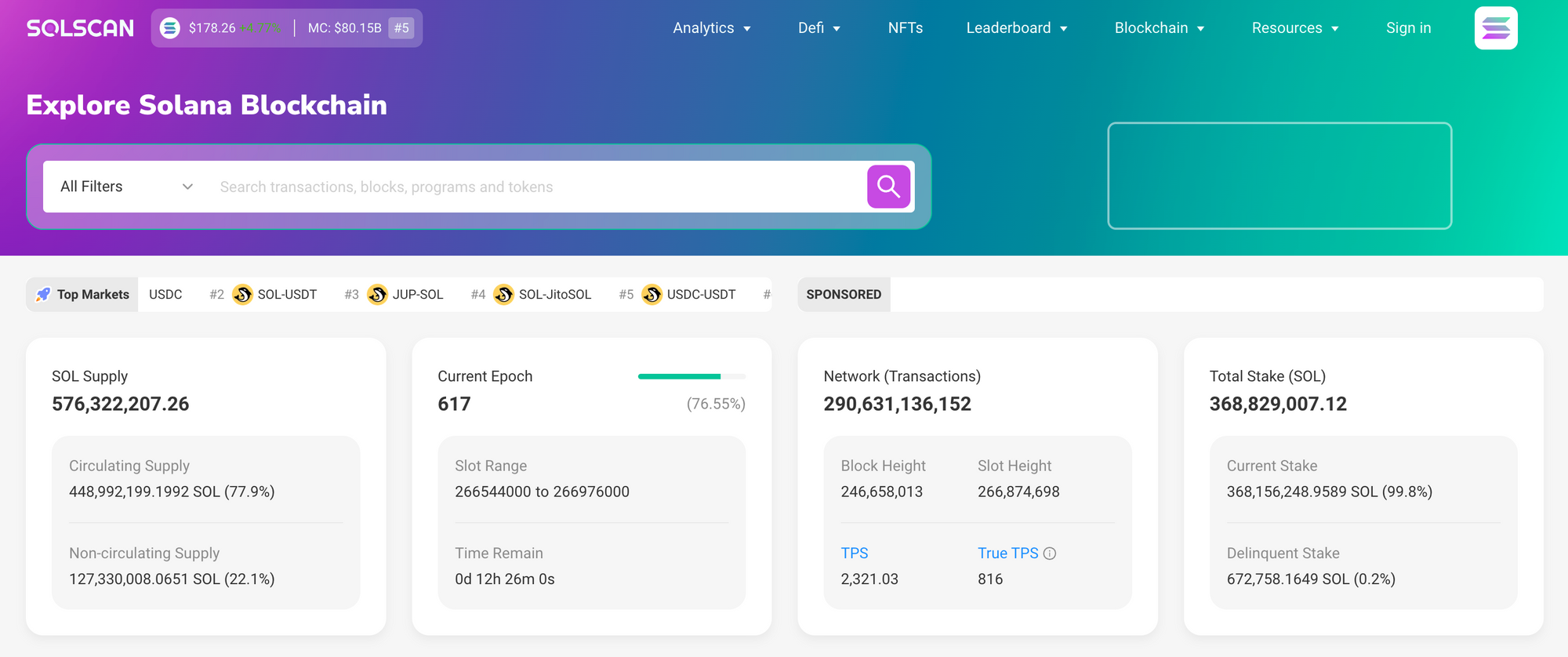
How I Use solscan When Tracking Tokens
I use it as my first-pass triage tool: check mint and holders, inspect transfers, read tx decodes, and then follow programs that get invoked.
If a token launch is happening, I monitor mint and freeze authority moves, watch liquidity entry via known pool addresses, and keep an eye on top-holder churn.
Sometimes the labels mislead or lag; that’s why I pair this with wallet-level checks and occasional RPC queries to confirm edge cases.
Mostly though, solscan speeds up the mundane parts of chain analysis so I can focus on the weird bits that actually need human judgment.
FAQ
Q: Can I trust the holder percentages on token pages?
A: They are a reliable starting point, but treat them as indicative not definitive.
Look for custodial or exchange addresses, wrapped assets, and program-owned accounts that can inflate or distort apparent concentration.
If precision matters, dig into each top account to see what it really represents.
Q: Does solscan support NFT metadata verification?
A: It shows on-chain pointers and sometimes previews metadata, but off-chain links can be broken or outdated.
Use the explorer to find the metadata URI, then verify the IPFS hash or server response independently if authenticity matters for purchases or grants.
Q: Is there a mobile-friendly workflow?
A: The interface is responsive enough for quick checks, but for deep dives you’ll want a desktop browser.
Notifications and watchlists mitigate the need to stare at pages all day though, so set alerts for the tokens you care about.
Okay—I’ll wrap up without a boring recap.
Solscan is not magic but it is very practical; it gives you clarity and context, and if you use it the way experienced users do you’ll avoid a lot of dumb mistakes.
If you want a direct link to check features and try token tracking yourself, try solscan.
I’m biased, sure, but I’ve found it worth the bookmark.
Now go poke at a token and see what story the chain tells—you might be surprised by what you find… really.
Albums | Why Trending Tokens Move When Volume Spikes — A Trader’s Take Using dex screener
Posted by Spice on March 7, 2025
Whoa! I was staring at a candle chart the other night and one small cap token went supernova in under ten minutes. My gut said “pump”, but my head kept ticking through variables—liquidity, wallet distribution, and whether bots were playing tag. Initially I thought volume alone explained it, but then I noticed the on-chain transfers and a sudden spike in contract interactions; that changed how I parsed the move. Honestly, somethin’ felt off about the velocity and I started digging deeper—fast, messy, and a little obsessed.
Here’s the thing. Short-lived trending tokens are noisy. They often show huge percentage moves on tiny pools where a single whale or a bot can shift price massively. On the other hand, sustained trends usually have backing volume that correlates with real buys across multiple wallets over time, not just one huge swap. So you need to filter the noise from genuine demand, which is harder than it sounds because bots imitate human patterns very very well. I’ll be blunt: if your strategy is “buy the heat” without a plan you will get burned more often than not.
Really? Yep. My instinct said “sell into the spike” a lot of times, though sometimes holding worked out better—context matters. On one hand, a spike tied to a news event or listing can be a durable catalyst; on the other hand, a coordinated liquidity grab can mask a rug. Actually, wait—let me rephrase that: look for supporting signals beyond the candle. Transaction counts, new holder percentage, and transfer sizes are the sorts of confirmations that matter. If those are missing, treat the move like a short-term event unless you have a high risk tolerance.

How I Track Trending Tokens (and what I actually watch)
Okay, so check this out—when a token starts trending I open a live monitor and watch three things first: 24h trading volume, liquidity pool ratio, and number of new unique buyers. Then I watch the flow—are funds moving out to many wallets, or just to one? Something bugs me about charts that only show price; volume tells the rest of the story. I’m biased, but tools that present real-time pair details save you from chasing false moves, and that’s why I use dex screener to cross-check pairs and watch for immediate liquidity changes.
Volume spikes can mean different things depending on context. A genuine breakout typically shows rising price with rising volume across multiple bars and increasing unique buyer counts—this is classic confirmation. A suspicious spike has huge price movement on a single trade with minimal subsequent transactions; often liquidity is pulled shortly after and the smart contracts sometimes have transfer limits or hidden taxes. On-chain explorers will tell you more about contract creation time and verified source code, though actually parsing contract code takes patience and practice.
Hmm… about slippage and execution—traders underestimate the impact of low liquidity. If the pool has low depth your buy will push price up and your sell will push it down; pay attention to the quoted price impact and simulate trades before committing. Sandwich attacks and MEV bots love shallow pools with predictably timed transactions (like pending mempool entries), so using smaller order sizes or breaking buys into tranches can reduce risk. Also, check tokenomics: transfer tax, burn functions, and minting privileges are all red flags if not openly explained.
On the analytical side, volume-to-market-cap ratio is a useful quick metric. If 24h volume is more than, say, 5-10% of the circulating market cap, that’s meaningful liquidity—and it can be a real signal for volatility ahead. Though actually, numbers lie without context: centralized listings, cross-chain bridges, and wrapped assets can inflate apparent volume. So correlate with on-chain transfers, contract events, and social signals (like developer posts or verified listings) before sizing positions. On a few occasions I misread community hype as durable demand—lesson learned.
Short checklist for vetting a trending token: contract verified and audited? Check. Liquidity pool owned by a multisig or locked? Check. Reasonable holder distribution (not 2 wallets holding 80%)? Check. Rising unique buyer count and sustained volume over several candles? Check. If any of these are missing, proceed with extreme caution. This is simple but it works—mostly.
Practical trade rules I use with volatile tokens
Keep sizes small. Use a consistent max-per-trade rule (I use percentages of my portfolio). Have an exit plan before entry—think partial profit-taking at predetermined thresholds and a hard stop if price action collapses. Consider the time frame: some pumps cool off in 30 minutes, others take days—align the exit to the expected event horizon. I’ll be honest: emotional exits are where most traders fail.
Also—watch for wash trading. On some DEXs, pairs show huge
Mix | Check out Kap Slap’s No Resolutions mix
Posted by APM on January 17, 2017
Facebook | Soundcloud | Twitter
Following a massive 2016, Kap Slap is back with a new installment of his famous hour long mixes. Leading off with his monster mashup “Heathens Love Theives”, this mix is chalk full of Kap Slap’s signature mashups and hard charging remixes. Kap Slap leads into 2017 with “no resolutions” after being named one of BPM’s artists to watch in 2017, announcing massive festivals like “Hangout Fest” and wrapping up 2016 with the massive release of “Felt This Good.” Keep your head on a swivel friends because Kap is teasing new originals and tour dates weekly.
Techno | Point Blank Shares About History Of Techno Music
Posted by VMan on November 17, 2016
Techno fans have a special treat today. The electronic music school has released a video discussing not only the history of techno music, but also production tips discussing, in detail, elements of education for the Ableton user. James Wiltshire, who has been featured talking about historical and production points with Point Blank before, uses his charming UK voice and impressive intellect to deliver a balance of history and knowledge.
Dope facts you probably didn’t know if you got into dance music this decade: Derrick May and Kevin Saunderson began to create what is now known as early Detroit Techno. Early tech-heads were influenced by the book Third Wave – I won’t give away any more interesting facts – but the video is worth the watch.
For more info about this video or about Point Blank’s music classes, you can follow the link here: www.pointblankmusicschool.com